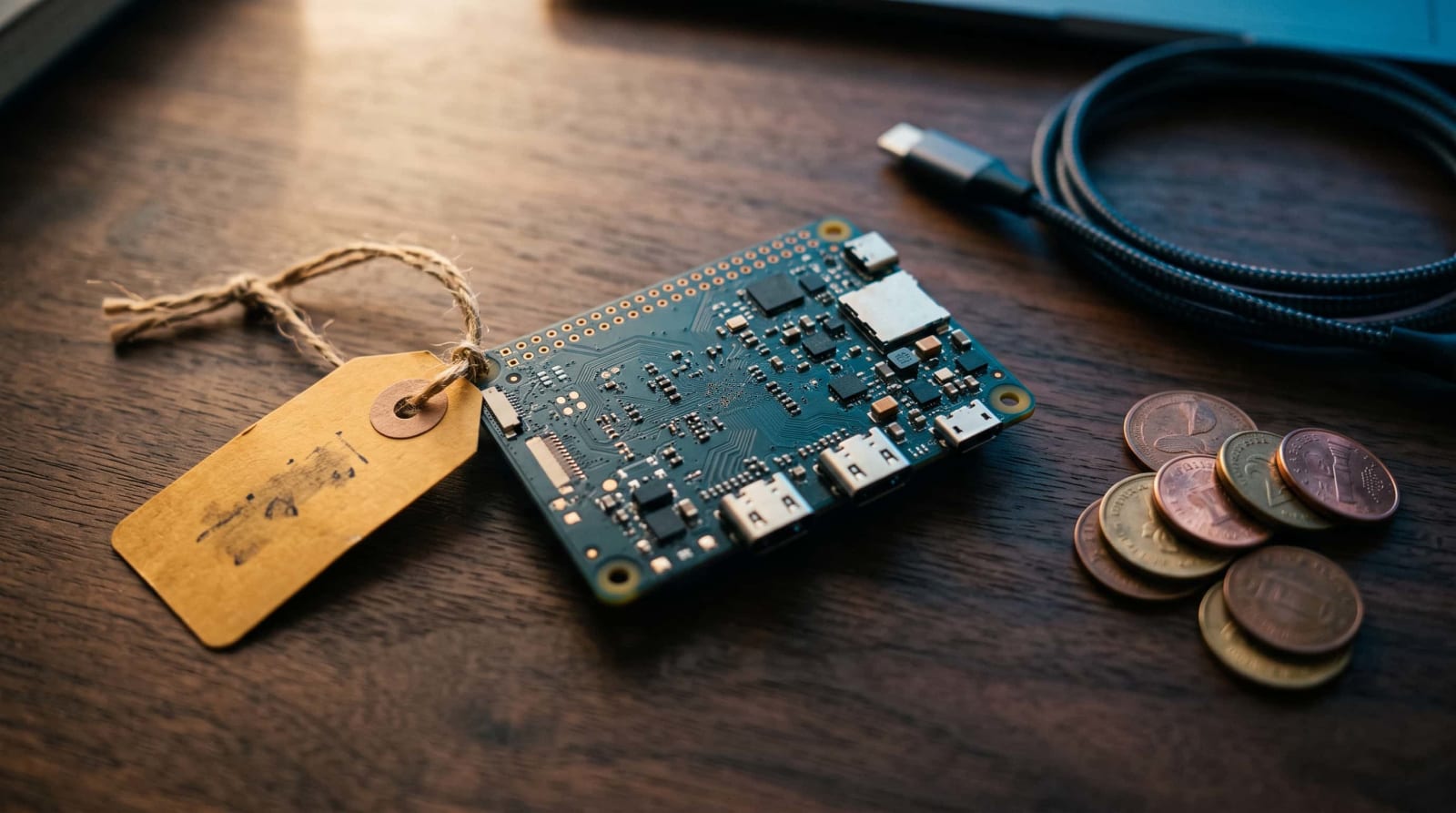
It is a chilly October weekend, you have some hours to spare, and you intend to do something simple: a little box to block advertisements, and a family media library. Then you see what you have in the cart. A 2GB Pi 5 board is currently priced at 77.50, and you have not included a power supply, a case, and a storage device yet. It was the sticker shock many American tinkerers experienced this fall. This is what has changed, why, and how to make a decision to buy, wait, or take an alternative.
Quick Answer: Raspberry Pi will raise the cost of its 2GB Pi 4 and Pi 5 boards by $12.50 on October 1, 2026 to make them $67.50 and $77.50 due to the continued rise of memory chip prices (Source: Raspberry Pi Ltd, via Phoronix). A Pi remains reasonable in small, low-power, single-function applications, but a small Intel mini PC can oftentimes provide you with more server on the same budget. In case you purchase a Pi, choose the least amount of memory space that you need because you cannot expand it in the future.
What Is the Latest Raspberry Pi Price Increase?
Raspberry Pi increased the prices of its two lowest end mainstream memory sizes on October 1, 2026. The 2GB Pi 4 increased by $12.50 to 67.50, and the 2GB Pi 5 increased by 12.50 to 77.50 (Source: Raspberry Pi Ltd announcement, as covered by Phoronix and The Register ).
The two boards were spared the April round of increases, when only the 4GB and bigger models became more expensive. This was the first occasion when CEO Eben Upton declared that it was no longer possible to maintain the line (Source: Raspberry Pi Ltd, via Phoronix).
The following remained:
- The 1GB Pi 4 is still $35, and the 1GB Pi 5 is still $45.
- The 2GB Compute Module 4 and Compute Module 5 keep their current prices.
- This update did not apply to older boards, such as the Pi Zero and Pi 3 line. (Source: Raspberry Pi Ltd)
The context matters. The 2GB Pi 4 debuted at $45 in 2019, so it now costs about 50% more than on day one (Source: OMG! Ubuntu). In August 2024, the 2GB Pi 5 started at 50USD, increasing the new tag by 55 percent, and it is already the third price increase in that board in about ten months (Source: Hardware Busters).
Raspberry Pi 5 2GB Price Today, Plus Every Other Model
The following table shows list prices today versus launch prices, so you can see how much each board has strayed (Source: Raspberry Pi Ltd list prices, as reported by Phoronix, The Register and Hackster.io).
| Board | Launch price | Price today | Change vs. launch |
|---|---|---|---|
| Pi 4, 1GB | $35 | $35 | 0% |
| Pi 4, 2GB | $45 | $67.50 | +50% |
| Pi 5, 1GB | $45 | $45 | 0% |
| Pi 5, 2GB | $50 | $77.50 | +55% |
| Pi 5, 4GB | $60 | $110 | +83% |
| Pi 5, 8GB | $80 | $180 | +125% |
| Pi 5, 16GB | $120 | $305 | +154% |

There are two lessons to be learnt. The larger the memory, the larger the jump and the 16GB board is increased over 150%. The only boards that retain their initial cost are the 1GB boards.
The retailers dictate their own final prices and therefore tax, shipping and stock levels can drive up or down what you pay.
Why Are Raspberry Pi Prices Going Up?
In brief: memory chips became limited and very costly and currently, memory represents the majority of the price in many small boards (Source: Jeff Geerling, April 2026 analysis).
According to Raspberry Pi, the reason was a sudden rise in the price of LPDDR4 memory, which was caused by AI data-center build-out competition on chip-factory capacity. The company had pointed out in an earlier update that certain components had increased in price by over two times in just one quarter. The news page of Raspberry Pi gives its explanation.
Consider it as a busy highway. The chipmakers are dispatching their finest trucks to large server clients, thereby making the small buyers wait longer and incur a higher price. TrendForce is a market research firm that predicts that traditional memory contract prices will increase by an additional 10-15 percent in the upcoming quarter since suppliers are more inclined to purchase server products (Source: TrendForce, September 30, 2026).

The CEO of Micron also informed investors that in 2027 and 2028, the supply of memory will probably be even tighter than it was in 2021 (Source: Micron earnings call, as reported by TechPowerUp).
Will Raspberry Pi Prices Come Back Down?
Eventually, maybe. Upton has described the situation as a temporary one, and has expressed a desire of the company to undo its increases as soon as costs of memory become less (Source: Raspberry Pi Ltd, via The Register).
However, as suppliers continue to suggest a tight supply into 2027, it is dangerous to plan on a rapid decline. Buy today, not to sell tomorrow.
Is Raspberry Pi 5 Worth It Right Now?
It depends on the job. A Pi remains the most suitable tool in some projects. To some it is no longer the low end choice.
A Pi retains its place when you require:
- Small size and noiseless operation. It can be placed practically anywhere.
- Extremely low power consumption. Pi boards consume between 2 to 4 watts idling, compared to approximately 6 to 9 watts of typical mini PCs (Source: Serverman home-server buyer's guide).
- GPIO pins. These allow connecting sensors, relays, and homemade electronics.
- The largest collection of novice tutorials. When anything breaks, it has likely been posted how to fix it.
A mini PC typically prevails when you require:
- A plethora of Docker apps simultaneously. All container images can be run on standard x86 chips without ARM surprises (Source: selfhosting.sh).
- Video transcoding. Intel processors come with Quick Sync, which is very useful when you are migrating Plex to Jellyfin or when you are streaming to multiple TVs.
- More memory at no Pi memory prices. A significant number of N100-class boxes include 16GB of RAM and a 500GB SSD.

It is important to remember that the bill consists only of the board. A Pi requires power supply, case, cooling and storage. By mid-2026, a fully equipped 8GB Pi 5 had landed within about 10% of a full-fledged N100 mini PC with 16GB of RAM and a 512GB NVMe drive (Source: Raspberry Tips). The prices of mini PCs are also being hiked by memory costs, so make a comparison with live listings before you make your decision.
The cost of power is low both ways. Idling at 7 watts, a mini PC costs around 9 cents per kilowatt-hour, or about 9 a year, and a Pi costs around 4 cents per kilowatt-hour or about 4 a year (Source: our calculation; verify your own rate with the U.S. Energy Information Administration).
Our verdict: a Pi is a good purchase when it fits your project due to its small size, low power consumption, or even its GPIO pins. Assuming that you simply want to run a few self-hosted applications, consider price out a mini PC.
Raspberry Pi 4 vs 5 for Home Server Projects
Our guide to what a home server actually does is a good place to begin in case you are new to all this. After knowing your workload, the decision between these two boards is largely based on memory size and budget.
When the Pi 4 Still Makes Sense
The cheapest Pi 4 or Pi 5 you can purchase is now the 1GB Pi 4 at $35. It is sufficient to ad block at DNS level or a small VPN gateway.
In case you need a safe remote access to your network, our Tailscale, NetBird, and Twingate comparison will assist you in selecting a tool that will operate on a small board.
When the Pi 5 Is the Better Buy
At 2GB, the Pi 5 costs just $10 more than the Pi 4 ($77.50 versus $67.50). To fill that gap you can get a much faster chip, and Raspberry Pi has priced that as about a threefold increase (Source: Raspberry Pi Ltd, January 2025 launch announcement). The Pi 5 also can use fast NVMe storage with add-on boards, which is a significant upgrade compared to SD cards in a 24/7 server.
Above 2GB, math becomes more difficult. The 4GB Pi 5 is $110 and the 8GB is $180. A full mini PC with more memory and storage is worth considering at such prices.
These are approximate rules of thumb, not hard rules, to use in sizing your memory:
| Project | Memory to aim for |
|---|---|
| DNS ad blocker | 1GB |
| VPN or small network tools | 1GB |
| Smart-home hub | 2GB to 4GB |
| A few Docker apps (password manager, uptime monitor) | 4GB |
| Family cloud storage or media for several people | 8GB or more, or switch to a mini PC |
Raspberry Pi Alternatives 2026: What to Buy Instead
You can choose more than Pi or nothing. Most beginners can make sense of three routes.

Small Intel Mini PCs
The typical community choice of a first server is boxes constructed around Intel N100 or N150 chips. They execute normal x86 applications and most of them have 16GB of RAM and an SSD (Source: selfhosting.sh). Idle power is usually in the range of 6 to 9 watts (Source: Serverman).
Prices are more volatile than ever, as memory prices strike these machines as well. Popular models were priced in the early-2026 range of around $190, with a few July 2026 listings approaching or above the price of $300 (Source: selfhosting.sh; TechFuelHQ). To get additional choices, visit our hardware guides.
Refurbished Business Mini PCs
Older office computers such as the Lenovo ThinkCentre Tiny, Dell OptiPlex Micro, and HP EliteDesk Mini can be the most cost effective per dollar. In 2026, the list of refurbished models with a Core i5 and 16GB of RAM included roughly between $90 and $220, depending on the configuration (Source: selfhosting.sh; TechFuelHQ).
There will be increased idle power of approximately 15 to 20 watts (Source: TechFuelHQ). Another thing to buy is to look at the seller return policy.
Older Pis and Other ARM Boards
Raspberry Pi itself indicates that the older boards, such as the Pi 3B, 3A+, and 3B+, might work with simpler projects as well (Source: Notebookcheck, reporting on the Raspberry Pi announcement). The models operate on older memory that the company claims it hoarded and this is why they have not seen their prices falling (Source: Raspberry Pi Ltd).
The Orange Pi and Libre Computer boards may seem cheap on paper. They too are subject to the same memory squeeze, and ARM software compatibility can sting (Source: Jeff Geerling on memory costs; selfhosting.sh on compatibility). That trade-off is not usually profitable to amateurs.
| Option | Typical price | Idle power | Best for | Watch out for |
|---|---|---|---|---|
| New N100/N150 mini PC | About $190 to $340 | 6 to 9 watts | Docker, media, virtual machines | Memory costs lifting prices |
| Refurbished business PC | About $90 to $220 | 15 to 20 watts | Best value and lots of RAM | Used condition, older chips |
| Pi 3B+ or Zero 2 W | Lowest cost | Very low | One tiny, simple job | Limited speed and memory |
| Other ARM boards | About $75 to $120 (older reviews) | 5 to 10 watts | Tinkering | Same memory pressure, thinner support |
Prices are not very accurate based on 2026 reviews, and they change frequently.
How to Save Money on Your Home Server Build
A couple of habits will help you keep your budget in check and memory is still expensive:

- Purchase the smallest memory size that is functional. Pi memory is solder pinned and newer firmware has boards locked to their initial capacity ( Source: Raspberry Pi engineer, as reported by The Register).
- Check out the entire package at once. Include the power supply, case, cooling and storage to board price.
- Install free hardware in the first place. A legacy desktop or laptop is able to execute the majority of novice stacks.
- Do not stinge with backups. Inexpensive storage does not work, and go with our ransomware-immune backup strategy.
- Extra sales seasonally at the shop. Our Prime Day deals homelab roundup includes SSDs, cables, and mini PCs.
Conclusion
This price rise is due to increasing memory costs and it is projected that it will be some time before relief sets in. The clever thing would be to suit the board to the task: a 1GB Pi to use on small tasks, a 2GB Pi 5 on small projects, and a mini PC when you need a full-fledged home server. Next, read our RAM price survival guide before spending another dollar on hardware, to learn how to stretch your hardware budget.
References
- Raspberry Pi Ltd, "More memory-driven price rises" (official news post): https://www.raspberrypi.com/news/more-memory-driven-price-rises/
- Raspberry Pi Ltd, announcement of the 16GB Raspberry Pi 5 (January 9, 2025), source of the "threefold performance" comparison (no URL listed)
- Phoronix, "Raspberry Pi 5 2GB Price Increases To $77.50 USD" (October 1, 2026): https://www.phoronix.com/news/Raspberry-Pi-5-2GB-Price-77.50
- The Register, "Once a $35 computer, the 2 GB Raspberry Pi 4 now costs $67.50" (October 2, 2026): https://www.theregister.com/personal-tech/2026/10/02/once-a-35-computer-the-2-gb-raspberry-pi-4-now-costs-6750/5300774
- The Register, "Cheaper 1 GB Raspberry Pi 5 lands as memory costs go through the roof" (December 1, 2025): https://www.theregister.com/2025/12/01/raspberry_pi_5_1gb/
- Hackster.io, "Raspberry Pi Announces Another Price Hike, Adding $12.50 to the Raspberry Pi 4, 5 2GB Variants": https://www.hackster.io/news/raspberry-pi-announces-another-price-hike-adding-12-50-to-the-raspberry-pi-4-5-2gb-variants-99e409599904
- OMG! Ubuntu, "A 2GB Raspberry Pi 4 now costs 50% more than it did at launch": https://www.omgubuntu.co.uk/2026/10/raspberry-pi-2gb-costs-how-much-now
- Hardware Busters, "Raspberry Pi 5 2GB Price Climbs to $77.50 as Memory Costs Finally Catch the Cheap Boards": https://hwbusters.com/news/raspberry-pi-5-2gb-price-climbs-to-77-50-as-memory-costs-finally-catch-the-cheap-boards/
- Notebookcheck, "Raspberry Pi announces new price hikes for 2 GB Pi 4 and Pi 5": https://www.notebookcheck.net/Raspberry-Pi-announces-new-price-hikes-for-2-GB-Pi-4-and-Pi-5.1413412.0.html
- TweakTown, "Raspberry Pi raises 2GB Pi 4 and Pi 5 prices by $12.50 as memory costs climb" (RAM firmware lock): https://www.tweaktown.com/news/113854/raspberry-pi-raises-2gb-pi-4-and-pi-5-prices-by-dollars12-50-as-memory-costs-climb/index.html
- TrendForce, "AI Server Demand Sustains Memory Contract Price Increases in 4Q26, While Consumer-Side Pressure Persists" (September 30, 2026): https://www.trendforce.com/presscenter/news/20260930-13258.html
- TechPowerUp, "Raspberry Pi Raises Prices of 2 GB Raspberry Pi 4 and Pi 5" (reporting Micron's earnings-call comments): https://www.techpowerup.com/353301/raspberry-pi-raises-prices-of-2-gb-raspberry-pi-4-and-pi-5
- Jeff Geerling, "DRAM pricing is killing the hobbyist SBC market" (April 1, 2026): https://www.jeffgeerling.com/blog/2026/dram-pricing-is-killing-the-hobbyist-sbc-market/
- Raspberry Tips, "Raspberry Pi 5 vs. N100 Mini PC: Which One Should You Buy?": https://raspberry.tips/en/smart-home/home-assistant-hardware-2026-raspberry-pi-5-or-n100-mini-pc
- selfhosting.sh, "Best Mini PCs for Home Servers 2026" and "Best Raspberry Pi Alternatives for Servers": https://selfhosting.sh/hardware/best-mini-pc/ and https://selfhosting.sh/hardware/raspberry-pi-alternatives/
- Serverman, "Best Mini PC for Home Server 2026": https://www.serverman.co.uk/server/home-server/best-mini-pc-home-server/
- TechFuelHQ, "Best Mini PC for Home Assistant 2026": https://techfuelhq.com/homelab/best-mini-pc-home-assistant-2026/
- U.S. Energy Information Administration, Electric Power Monthly: https://www.eia.gov/electricity/monthly/